On-chain asset management is managing other people's money through smart contracts on a public blockchain. Investors deposit into a vault, a manager trades the pooled capital, and the contract, not a fund administrator, keeps custody, issues shares, charges fees and records every trade. Anyone can check the result on the chain. This guide explains how it works, what it costs, how to judge a manager, and where its limits are. It links to our deeper guides on each part.
Key Takeaways
- On-chain asset management replaces the fund administrator, custodian and auditor's statement with a vault contract and a public ledger. The track record is the vault's own transactions.
- The question that matters most is who can move the money. In a non-custodial vault the manager can trade the deposits but has no instruction to withdraw them.
- Fees work like a fund's: a management fee on assets and a performance fee on profit, usually above a high-water mark. On-chain, every fee payment is a public transaction.
- You judge a manager by reading the vault: its holdings, its flows, its share price and the risk statistics that follow from it, not a screenshot of returns.
- It does not remove risk. Market losses, smart-contract bugs, admin keys and short track records are all still real.
About this guide: FBYT publishes it and runs one of the vault platforms described. FBYT's facts come from its own smart contract and its 12 November 2026 announcement; other platforms' terms come from their own documentation, checked on 17 November 2026. Terms change, so confirm them before you deposit. This is not financial advice, and capital is always at risk.
What Is On-Chain Asset Management?
On-chain asset management is the fund model run by code: a smart contract pools deposits, gives each investor shares, lets a named manager trade the pool under fixed rules, and pays the manager fees out of it. The rules and the history live on a public blockchain, so investors can verify them instead of trusting a statement.
The parts map closely onto a traditional fund:
| Traditional fund | On-chain equivalent |
|---|---|
| Fund (the legal pool of money) | Vault (a smart contract and the token accounts it controls) |
| Units or shares | Vault shares, minted on deposit and burned on withdrawal |
| Net asset value (NAV) per unit | Vault share price: the vault's value divided by shares outstanding |
| Custodian | The vault program itself, which owns the token accounts |
| Fund administrator | Contract logic that calculates shares and fees the same way every time |
| Monthly statement | The public ledger, readable at any time in an explorer |
If the fund vocabulary is new to you, start with what a hedge fund is and what AUM means. For a plain-English list of the on-chain terms, see the DeFi asset management glossary.
Crypto Asset Management vs On-Chain Asset Management
Crypto asset management is the broader term: any professional management of a portfolio of digital assets. On-chain asset management is one way to do it, where the pooling, custody, accounting and fees run in smart contracts instead of through a firm's own systems.
The difference shows up in three places:
- Where the assets sit. A crypto fund or managed account usually holds its coins with a custodian or an exchange. An on-chain vault holds them in accounts its program controls.
- How you invest. A crypto fund typically onboards you through subscription documents and its own checks. An on-chain vault takes a deposit from a wallet.
- How you check the results. A crypto fund reports to you. An on-chain vault's holdings, trades and fees are on a public ledger anyone can read.
Neither model is safer by default. A regulated custodian protects against some risks that a smart contract does not, and the reverse is also true. The rest of this guide covers the on-chain model.
How Is It Different From a Hedge Fund or a Copy-Trading App?
The difference is who holds the money and who produces the record. A hedge fund holds your money through a custodian and reports its own results. A copy-trading app holds your money on an exchange and copies orders into your account. An on-chain vault holds the money in contract-owned accounts and lets the chain produce the record.
| Hedge fund | Copy-trading app | On-chain vault | |
|---|---|---|---|
| Who holds the money | A custodian chosen by the fund | The exchange or broker | The vault's smart contract |
| What you own | Fund units | Your own positions, copied from a leader | Shares of one pooled portfolio |
| Who produces the track record | The manager, administrator and auditor | The platform's dashboard | The vault's own transactions |
| Who can check it | Investors, usually on request | Platform users, as the platform shows it | Anyone with the vault's address |
| Cost to start as a manager | A fund structure, lawyers, administration and audit | Platform approval | A vault and your own starting capital |
Launching a traditional fund is expensive. An article published by the Alternative Investment Management Association in March 2026 put the minimum budget at about US$100,000; see how to start a hedge fund for the full stack. Copy trading is cheap to join, but a copied order fills at its own price and your result drifts from the leader's. We explain why in copy trading vs asset management. If you are deciding whether to hand money to anyone at all, crypto vault vs trading yourself compares the two routes.
How Does an On-Chain Vault Work?
A vault works in four steps: you deposit and receive shares, the manager trades the pool, the share price moves with the portfolio, and you withdraw by returning shares for your slice of what the vault holds.
- Deposit. You send tokens from your wallet to the vault. The contract mints shares to you at the current share price, so a new deposit does not dilute anyone else.
- Trade. The manager sends trade instructions. On FBYT, trades route through Jupiter, Solana's swap aggregator, and the vault holds spot tokens, with no leverage inside the vault.
- Value. The vault's value is the market value of everything it holds. Divide it by the shares outstanding and you get the share price, the on-chain version of NAV per unit. Ethereum formalised this shares-for-deposits pattern as the ERC-4626 tokenized vault standard; Solana vaults follow the same idea with their own programs.
- Withdraw. You return shares and receive your proportion of the vault's assets in your wallet. On FBYT there is no lock-up: you can withdraw at any time, with no approval step.
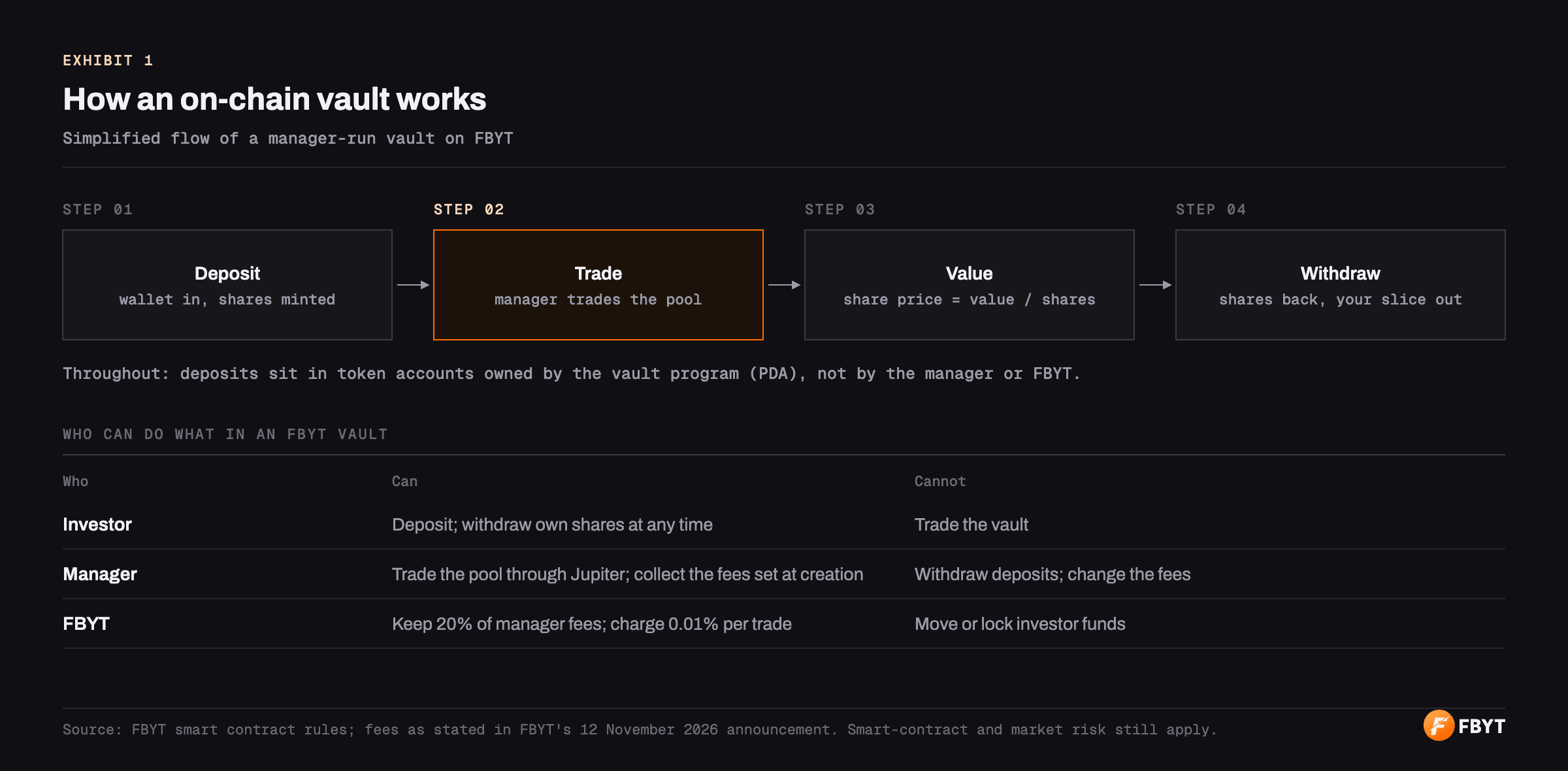
Exhibit 1. The manager trades the pool, but the deposits stay in accounts the vault program owns.
Vaults differ a lot in what they do with the money. A lending vault puts one token to work in lending markets, a protocol vault earns trading fees or basis yield, and a manager-run vault hands the pool to a trader. Four types of DeFi vaults compared walks through the trade-offs, and what is a crypto vault covers the basics.
Who Holds the Money? Custody and Its Limits
In a non-custodial vault, deposits sit in token accounts owned by the vault's program-derived address (PDA), an address only the vault program can sign for. The manager can tell the program to trade those tokens but has no instruction to withdraw them, and only your own wallet's signature can withdraw your shares.
That design narrows the risk. It does not remove it. The largest Solana DeFi loss of 2026 shows where the remaining risk sits. On 1 April 2026, attackers drained about $285 million from Drift Protocol, and TRM Labs found the weakness was not a smart-contract bug. Signers were tricked into approving hidden admin authorizations, a governance change had removed the time delay that might have caught them, and Drift's oracles accepted a fake token as collateral. Admin keys, upgrade rights and price feeds can matter as much as the vault logic.
Before you deposit anywhere, ask three questions:
- Which accounts hold my deposit, and who can sign for them?
- Who can upgrade or administer the program, and is there a delay before changes take effect?
- Has the code been audited, and is the report published?
What is a non-custodial vault explains the model in general. How FBYT's vault architecture keeps funds safe covers what FBYT can and cannot do, and where its security audit stands. For how Drift's model compares, see FBYT vs Drift vaults.
How Do Fees Work in On-Chain Asset Management?
Most manager-run vaults charge the two fees a hedge fund does: a management fee, a yearly percentage of the assets, and a performance fee, a share of the profit. A high-water mark stops the manager from being paid twice for the same gains. On-chain, the contract calculates and pays each fee, and every payment is a public transaction.
On FBYT the rules are fixed in the contract:
- The management fee accrues only while the vault is active. It builds up as shares owed to the manager and is paid out in the vault's own tokens when the manager collects it on the vault's fee schedule (weekly, monthly, quarterly or yearly) or when an investor withdraws.
- The performance fee is charged only when you withdraw, and only on profit above your own high-water mark: the dollar value you deposited. It is paid straight to the manager's token accounts.
- There is no entry or exit fee and no hurdle rate. A manager cannot change a vault's fees after it is created.
- FBYT's protocol share comes out of the manager's fees, not on top of yours: FBYT keeps 20% of the management and performance fees managers earn. Separately, FBYT charges 0.01% per trade, as it stated in its 12 November 2026 announcement.
A worked example (illustrative, not a forecast). You deposit $10,000 into a vault with a 2% management fee and a 20% performance fee. Your high-water mark is $10,000. Over a year the portfolio gains 25% before fees, to $12,500. The management fee, accruing over the year on a balance that grows from $10,000 to $12,500, comes to roughly $225, which leaves about $12,275. You then withdraw. The profit above your $10,000 mark is about $2,275, so the performance fee is about $455, and you receive roughly $11,820, a net return of about 18%. Of the roughly $680 in fees, the manager keeps about $544 and the protocol about $136. Had the vault lost money, you would have paid the management fee and no performance fee.
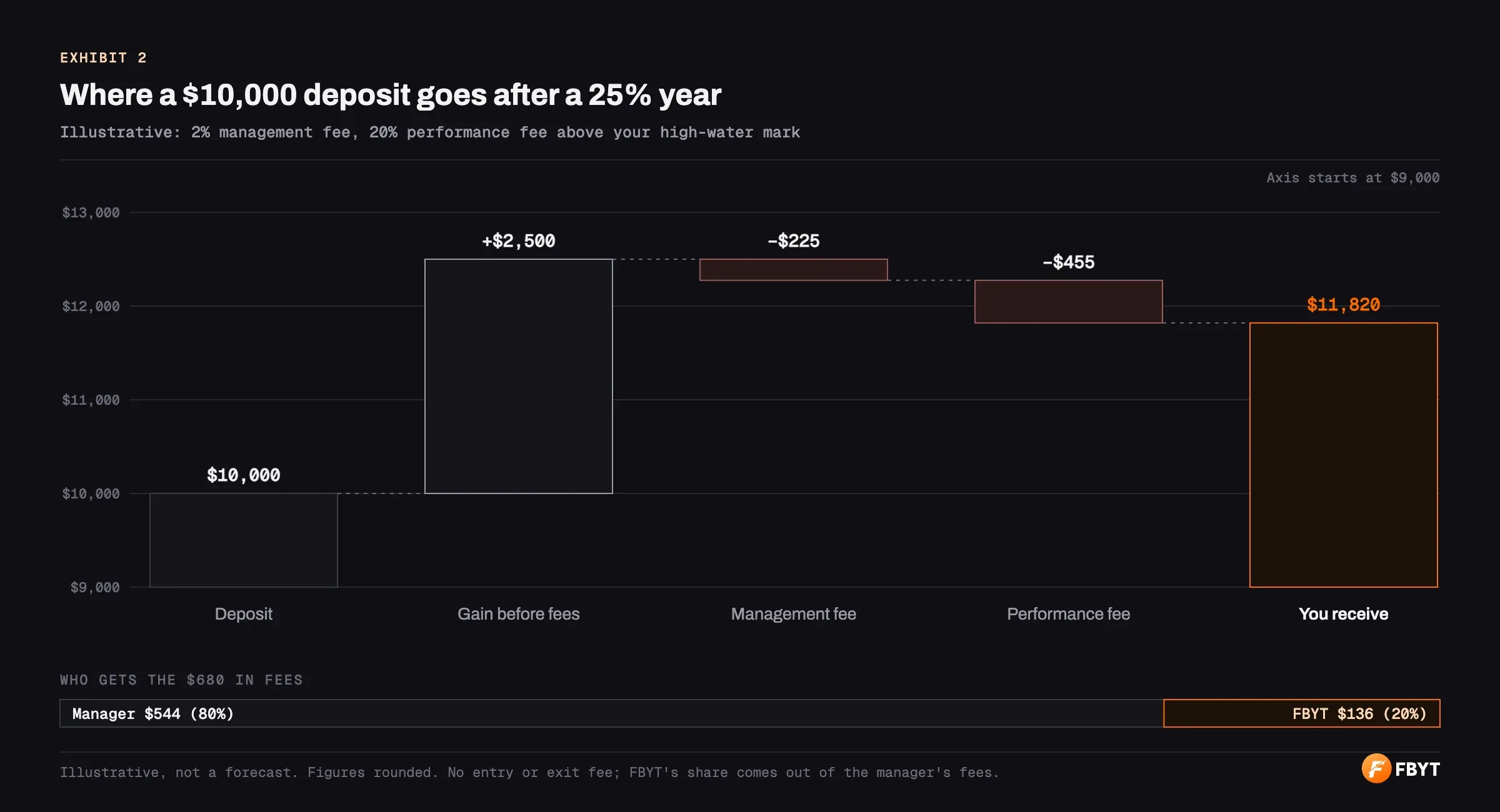
Exhibit 2. The same example as a chart. Of the roughly $680 in fees, about $544 goes to the manager and $136 to FBYT.
Our full guide to DeFi vault fees and the high-water mark covers fee stacks, share dilution and the questions to ask. For the manager's side, see how much a crypto money manager can earn.
How Do You Evaluate an On-Chain Manager?
Evaluate the vault, not the marketing. Confirm the vault's address and program, read what it holds, trace its deposits, withdrawals and trades, check its fee terms, then read the risk statistics that follow from its share price. On Solana this takes a few minutes in a public explorer.
The numbers worth reading:
- Track record length. How much evidence there is. A few months of data says little.
- Profit and loss, measured on the share price. Deposits and withdrawals change the vault's size but not its share price, so a share-price return is not inflated by new money.
- Maximum drawdown. The worst peak-to-low fall an investor would have sat through.
- Volatility, Sharpe and Sortino ratios. Return per unit of total risk, and per unit of downside risk.
- Beta to SOL. How much of the result came from SOL's own price moves rather than the manager's decisions.
FBYT shows these on each vault's page and recalculates them daily, with risk statistics appearing after 30 days of history. Then check them yourself. How to read a Solana vault on-chain is a step-by-step tutorial, including the red flags to look for. FBYT's $1M allocator announcement, linked in the fees section above, explains what each metric tells an allocator and what it does not show.
Where Can You Do On-Chain Asset Management Today?
On Solana, the options fall into three groups: lending vaults (Kamino, Jupiter Lend), protocol vaults (Jupiter's JLP pool, Solstice) and manager-run strategy vaults (Neutral Trade, Exponent and FBYT). On other chains, Hyperliquid runs perpetual-futures vaults on its own exchange, and Enzyme and dHEDGE (now Chamber) run on EVM chains such as Ethereum.
They differ on custody, on what the manager can trade and on how fast you can get out. Neutral Trade runs curated market-neutral strategies, some with an exchange leg, and pays out withdrawals on a fixed weekly or twice-weekly schedule for most of its vaults. Hyperliquid's user vaults trade perpetual futures, pay the leader a 10% profit share and have a one-day lock-up. FBYT vaults trade spot tokens on Solana through Jupiter, any manager can launch one, and investors can withdraw at any time. On 12 November 2026, FBYT reported more than 600 vaults, more than 1,000 users and more than 3,000 trades, across 40+ crypto assets and 10+ tokenized stocks.
Our comparisons go platform by platform:
- Best Solana vaults (2026): eight live options compared on custody, fees and withdrawals.
- Neutral Trade vs FBYT: curated strategies versus open manager vaults on Solana.
- FBYT vs Hyperliquid vaults: spot on Solana or perps on Hyperliquid.
- FBYT vs Enzyme and FBYT vs dHEDGE: Solana vaults against the established EVM platforms.
How Do You Become an On-Chain Money Manager?
You become an on-chain money manager by launching a vault: connect a Solana wallet, set the vault's fees and terms, deposit your own capital and start trading. Your track record builds in public from the first deposit. There is no application, no approval queue and no minimum AUM.
On FBYT you can start privately. A private vault is left out of the Invest list and search, and you fund it with your own money while the record builds. When you are ready, you turn the private setting off, and investors can find the vault and deposit under its terms. The record is not reset. Because fees cannot change after creation, decide them before you start the record you plan to show.
Two guides cover the details: how to become an on-chain money manager on Solana for the business side, and how to launch a DeFi vault on Solana for the step-by-step setup.
What Are the Risks and Limits?
On-chain asset management makes custody and records verifiable. It does not make returns safe. These risks remain:
- Market risk. A vault can lose value like any portfolio. A manager's past record does not guarantee future results.
- Smart-contract and admin risk. A bug, a compromised admin key or a bad price feed can put pooled deposits at risk. Check audits and upgrade rights.
- Manager risk. The manager decides the trades. A short or lucky record can look better than the strategy deserves.
- Liquidity risk. Your withdrawal is paid from what the vault holds. Thinly traded tokens can be worth less when sold.
- What the record does not show. A vault's history starts when the vault does. It does not show the manager's other vaults or anything off-chain.
Read the vault before you deposit, size your deposit to what you can afford to lose, and treat any single vault as one position, not a whole plan.