

FBYT publishes this guide, so we have a stake in which route you choose. We built it from published research, each venue's own fee documentation and the FBYT smart contract, and linked every statistic to its source. Last checked: 19 October 2026. Fees, pool tiers and prices change, so confirm current terms before you trade or deposit. This is not financial advice, and capital is always at risk.
If you hold crypto and want it to do more than sit in a wallet, the first decision is whether to trade it yourself or hand it to a manager. Trading yourself means a centralised exchange (CEX) such as Binance, or a decentralised exchange (DEX) you reach from your own wallet. Handing it over usually means a managed crypto vault, where a manager trades a pooled balance under rules set by a smart contract.
This guide compares the three routes on retail trading evidence, cost, custody and time, then gives you a vetting checklist and a table to help you choose.
Key Takeaways
- Trading yourself gives full control and is cheapest if you trade rarely, but long-standing evidence, mostly from non-crypto markets, shows most retail traders lose money or fail to beat the market after costs.
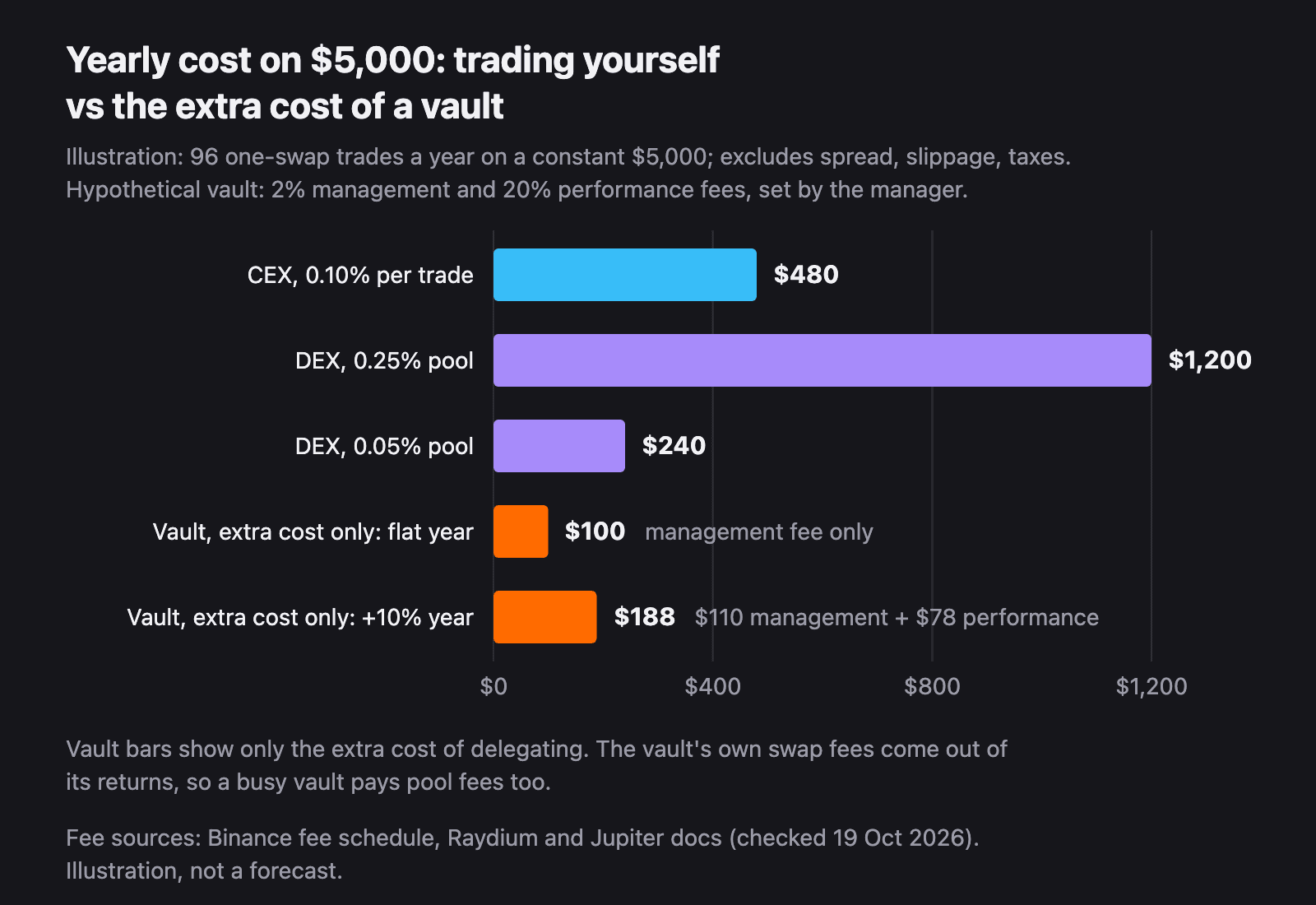
- In a $5,000 illustration with 96 trades a year, trading fees came to $480 on a CEX and $240 to $1,200 on a DEX. A vault charging 2% management and 20% performance fees added $100 to $188 on top of its own trading costs.
- A vault swaps your trading decisions for a manager's. It adds fees and manager risk, and it does not remove market risk.
- Custody differs on every route: an exchange holds your coins, a DEX leaves them in your wallet, and on FBYT deposits sit in token accounts owned by the vault's program-derived address.
- Before depositing, check a vault's custody model, fees, on-chain record, withdrawal terms and audit status.
Three Ways to Put Crypto to Work
Two routes are do-it-yourself; the third hands the trading decisions to someone else.
Trading on a CEX. You deposit funds into an exchange account and trade on its order book, and the exchange holds your coins while they sit there. In the UK it is the most common route: the FCA's 2025 consumer research found that centralised exchange use among UK crypto users rose to 73%.
Trading on a DEX. You connect a self-custody wallet and swap tokens through on-chain liquidity pools. On Solana, an aggregator such as Jupiter routes each swap through one or more pools. Nobody holds your funds between trades, but you sign every transaction and own every mistake.
Using a managed vault. "Vault" is used loosely in crypto: some firms mean a custody service, and some exchanges mean an earn product. Here it means a pooled on-chain account where investors deposit and receive shares, and a money manager trades the pool within rules enforced by a smart contract. You pick the vault; the manager picks the trades. Our explainer on what a crypto vault is and how it works covers the basics.
Between a CEX and a DEX, the choice is mainly about custody and convenience. A CEX offers order books, fiat on-ramps and customer support, but it holds your coins. A DEX leaves them in your wallet, but you handle keys, network fees and token risk yourself. Our CEX vs DEX comparison covers fees and features in detail. In this guide, both count as trading yourself.
What Does the Evidence Say About Trading Yourself?
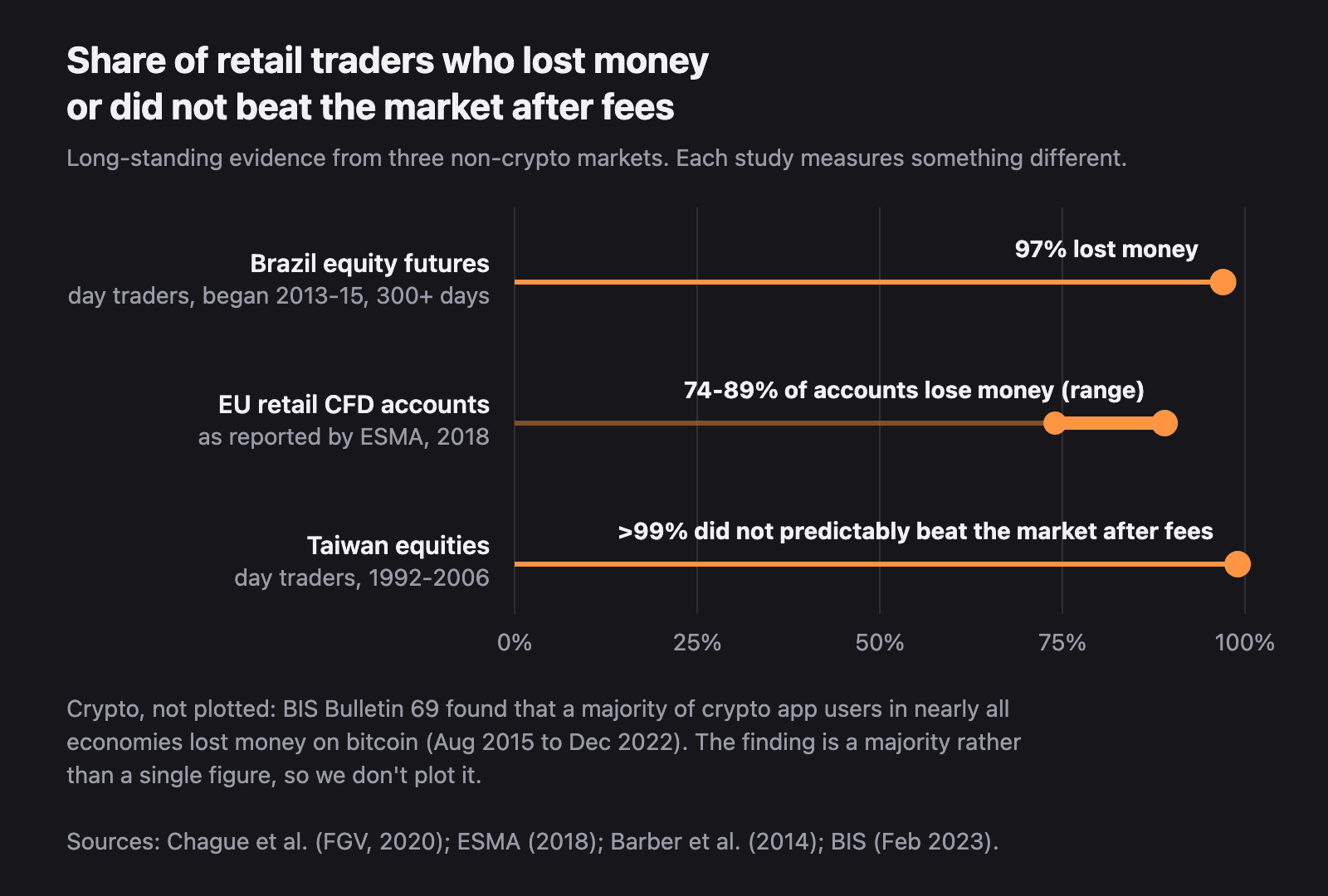
Long-standing research points one way: most retail traders lose money, and very few beat the market after costs for long. The strongest studies come from futures, equity and CFD markets rather than crypto, and none of it is 2026 data, so treat it as a base rate rather than a forecast.
Crypto. The Bank for International Settlements estimated that a majority of crypto app users in nearly all economies made losses on their bitcoin holdings from August 2015 to December 2022 (BIS Bulletin 69, February 2023). That reflects when people bought, not how actively they traded. The finding is a majority rather than a single figure, so we don't plot it below.
Brazilian equity futures (not crypto). Chague, De-Losso and Giovannetti followed people who began day trading Brazilian equity futures between 2013 and 2015 and kept at it for more than 300 days. 97% lost money, and only 0.4% earned more than a bank teller, about US$54 a day. The authors found no evidence that traders improved with experience.
Taiwan equities (not crypto). Barber, Lee, Liu and Odean studied Taiwanese day traders from 1992 to 2006 and found that fewer than 1% could predictably earn positive abnormal returns net of fees, in other words beat the market after fees (Journal of Financial Markets, 2014).
EU retail CFDs (not crypto). When ESMA restricted contracts for difference for retail clients in 2018, it reported that 74-89% of retail CFD accounts typically lose money. CFDs are leveraged, so this is closer to leveraged crypto trading than to buying spot.
| Market and period | Finding | Source |
|---|---|---|
| Brazil equity futures, day traders who began 2013-2015 and persisted 300+ days (not crypto) | 97% lost money | Chague et al., FGV, 2020 |
| EU retail CFD accounts, reported 2018 (not crypto) | 74-89% of accounts typically lose money | ESMA, 2018 |
| Taiwan equities, day traders 1992-2006 (not crypto) | Fewer than 1% predictably beat the market after fees, so more than 99% did not | Barber et al., 2014 |
| Crypto app users, Aug 2015 to Dec 2022 | A majority in nearly all economies lost money on bitcoin; a majority rather than a single figure, so not plotted | BIS Bulletin 69, 2023 |
The studies measure different things (losing money, not beating the market after fees, accounts in loss), so compare them with care. They also apply to managers, who are traders too. The evidence is a reason to be honest about your own odds, not proof that delegating works.
What Does Each Option Cost?
Trading yourself costs a fee on every trade, win or lose. A vault charges a management fee over time and a performance fee on gains. Which costs less depends mostly on how often you trade and, on a DEX, which pools your swaps use.
Trading on a CEX
Binance's standard spot rate is 0.10% for makers and takers, or 0.075% if you pay fees in BNB, checked on 19 October 2026. Spread and slippage come on top.
Trading on a Solana DEX
A Solana swap has three layers of cost:
- Pool fee, paid to liquidity providers. Raydium's AMM v4 pools charge 0.25%, and its CPMM and CLMM pools default to 0.25%, with tiers from 0.01% to 4%.
- Aggregator fee. Jupiter's platform fee is 0 bps on some pairs, 2 bps for SOL-stablecoin, 5 bps for liquid staking token to stablecoin, 10 bps for others and 50 bps for tokens under 24 hours old.
- Network fee. Solana charges a base fee of 5,000 lamports per signature plus a priority fee, and failed transactions still pay. At a SOL price of $105.75 on 19 October 2026, the base fee is about $0.0005.
Investing in a Managed Vault
Each vault sets its own fees. On FBYT, the manager sets a management fee and a performance fee when launching a vault, and both are shown on each vault.
The management fee accrues over time. The performance fee is charged when you withdraw. It applies only to gains above your deposit's USD value. FBYT charges no entry or exit fee (some tokens carry their own transfer fees). FBYT's protocol share comes out of the manager's fee, not on top of it. Our guide to how vault management and performance fees work explains the mechanics.
A Worked Example: $5,000 for One Year
This is an illustration, not a forecast, using the fee rates above. It assumes:
- $5,000 invested for one year.
- The balance stays constant at $5,000.
- Each trade is one swap of the whole balance, so 96 trades are 48 round trips.
- No spread, slippage or taxes.
- The DEX rows assume a pair with no Jupiter platform fee.
- The vault is hypothetical, charging 2% management and 20% performance. The management fee is simplified to 2% of the year-end value, and the performance fee is charged when you withdraw at year end.
| Route | Assumption | Yearly cost |
|---|---|---|
| CEX | 0.10% per trade, 96 trades | $480 |
| DEX, 0.25% pool | 0.25% per trade, 96 trades | $1,200 |
| DEX, 0.05% pool | 0.05% per trade, 96 trades | $240 |
| Vault, flat year | 2% management fee, no performance fee | $100 |
| Vault, +10% gross year | $110 management plus $78 performance (20% of the $390 gain left after the management fee) | $188 |
Paying Binance fees in BNB cuts the CEX figure to $360. SOL-stablecoin pairs carry a 2 bps Jupiter fee, adding $96 to either DEX row, and a 10 bps fee would add $480. Solana network fees for 96 swaps come to roughly $0.05 to $1 a year, depending on priority fees. The pool-fee tier is the biggest driver on a DEX: the same 96 trades cost $240 or $1,200, and Raydium's lower fee tiers mean liquid pairs can cost far less than the 0.25% default.
The vault rows show the extra cost of delegating, not the vault's full cost. A vault's own swap fees and slippage come out of its returns, so a busy vault pays pool fees too, and the flat or +10% result is already after them. If you and the manager would trade the same way, delegating costs more by the amounts shown. It pays only if the manager makes better decisions than you would.
Timing differs too. Your own trading fees are due on every trade, whether it wins or loses. The performance fee applies only above your deposit's value, so a flat or losing year costs only the management fee. And if you rarely trade, doing it yourself is hard to beat: at 0.10% a trade, $100 covers 20 full-balance trades a year.
Who Holds Your Money on Each Route?
An exchange holds your money on a CEX, you hold it on a DEX, and in a managed vault it depends on the design. Each route fails in a different way.
On a CEX, the Exchange Holds It
You hold a claim on the exchange, not the coins themselves. If the exchange fails or commits fraud, that claim is at risk: FTX customers lost $8 billion, according to the sentencing judge, as reported by Reuters via Business Insurance. Theft is the other risk. Chainalysis estimates that more than $3.4 billion in crypto was stolen from January to early December 2025, including about $1.5 billion in the Bybit exchange hack.
On a DEX, Your Wallet Holds It
No exchange stands between you and your funds, and nobody can recover them for you. Lost seed phrases, phishing and malicious token approvals are your risk to manage. Chainalysis found that personal wallet compromises made up 20% of the value stolen in 2025, about $713 million, down from 44% in 2024.
In a Managed Vault, It Depends on the Design
Ask where deposits sit and who can move them. On FBYT, deposits sit in token accounts owned by the vault's program-derived address (PDA), an address only the program can sign for. The manager, or a trading delegate the manager appoints (such as a bot key), trades those assets through Jupiter, and the manager has no instruction to withdraw investor principal. The manager can still collect the fees set at launch, bad trades still lose value, and a bug in the program itself remains a risk. Our guide to what non-custodial really means for vault safety covers this model.
Other vaults put an operator in the middle. In November 2025, Stream Finance suspended deposits and withdrawals after an external fund manager reported a loss of about $93 million. The loss sat with a manager trusted with the money, not in a smart contract.
Time, Skill and Behaviour
Trading yourself takes hours and discipline. Delegating swaps that for choosing and monitoring a manager, which takes less time but has its own traps.
Behaviour is often a bigger risk than fees. A study of 200,000 eToro traders by Kogan, Makarov, Niessner and Schoar found that in crypto they followed a momentum-like strategy, buying after prices rose, unlike their trading in stocks and gold (Journal of Financial Economics, 2024). Add research, monitoring and tax records, and trading becomes a part-time job, as our realistic beginner's guide to day trading crypto sets out.
Delegating is not free of these traps. IOSCO's 2025 report on online retail trading, as summarised by Investment Executive, warned that copy-trading followers can suffer significant losses when lead traders take high risks, that strategies may not suit the people copying them, and that conflicts of interest need managing. Before copying anyone, read how copy trading works and whether copy trading is profitable. The momentum trap applies to vaults too: picking last month's top performer is return-chasing in a different wrapper.
How to Vet a Vault Before You Deposit
Most of these checks can be done with public, on-chain data.
- Who controls the funds. Find where deposits sit and which keys or programs can move them. If an operator or exchange holds part of the capital, you carry its risk too.
- Fees. Note the management and performance rates, what the performance fee is measured against, and any entry or exit fee.
- On-chain track record. Look at trades, value over time and the worst drawdown, not just a headline return. Our guide on how to check a Solana vault on-chain walks through it.
- Strategy and assets. Know what the vault trades. Thin, illiquid tokens mean more slippage.
- Withdrawal terms. Read the vault's withdrawal terms: when you can withdraw and what you receive.
- Audit status. Look for a published independent audit report and read its findings. FBYT's vault program has been through an internal security audit, and FBYT is working with external auditors. No independent audit report has been published yet.
- Position size. Start with an amount you could afford to lose.
Which Route Fits You?
Choose by your time, experience, cost sensitivity and the custody risk you would rather carry.
Take a holder with $5,000 and about two hours a week. That is enough time to compare a few vaults' records and fees and check in on them, but not to follow markets closely, so frequent self-trading is a poor fit. If the same person enjoys trading and wants to learn, a small balance traded rarely through low-fee pools, sized as money they could lose, can sit alongside a vetted vault.
| Factor | Trading on a CEX suits you if... | Trading on a DEX suits you if... | A managed vault suits you if... |
|---|---|---|---|
| Time | You can follow markets most weeks | You can follow markets and manage a wallet | You would rather review a manager now and then than trade |
| Experience | You know order types and position sizing | You are comfortable signing transactions and spotting bad tokens | You can judge a manager's record and fee terms |
| Cost | You trade rarely or qualify for low fees | You trade liquid pairs through low-fee pools | You accept paying fees for someone else's decisions |
| Custody | You accept the exchange holding your coins | You want to hold your own keys | You prefer a program-controlled account and accept program and manager risk |
Many holders combine routes: a long-term position in their own wallet, a small trading balance and an allocation to a vault they have vetted. Size each part as money you could lose.
If a managed vault fits, you can explore vaults on FBYT. Each vault shows the fees its manager set, and its trades are recorded on-chain. Run it through the checklist above before you deposit.


