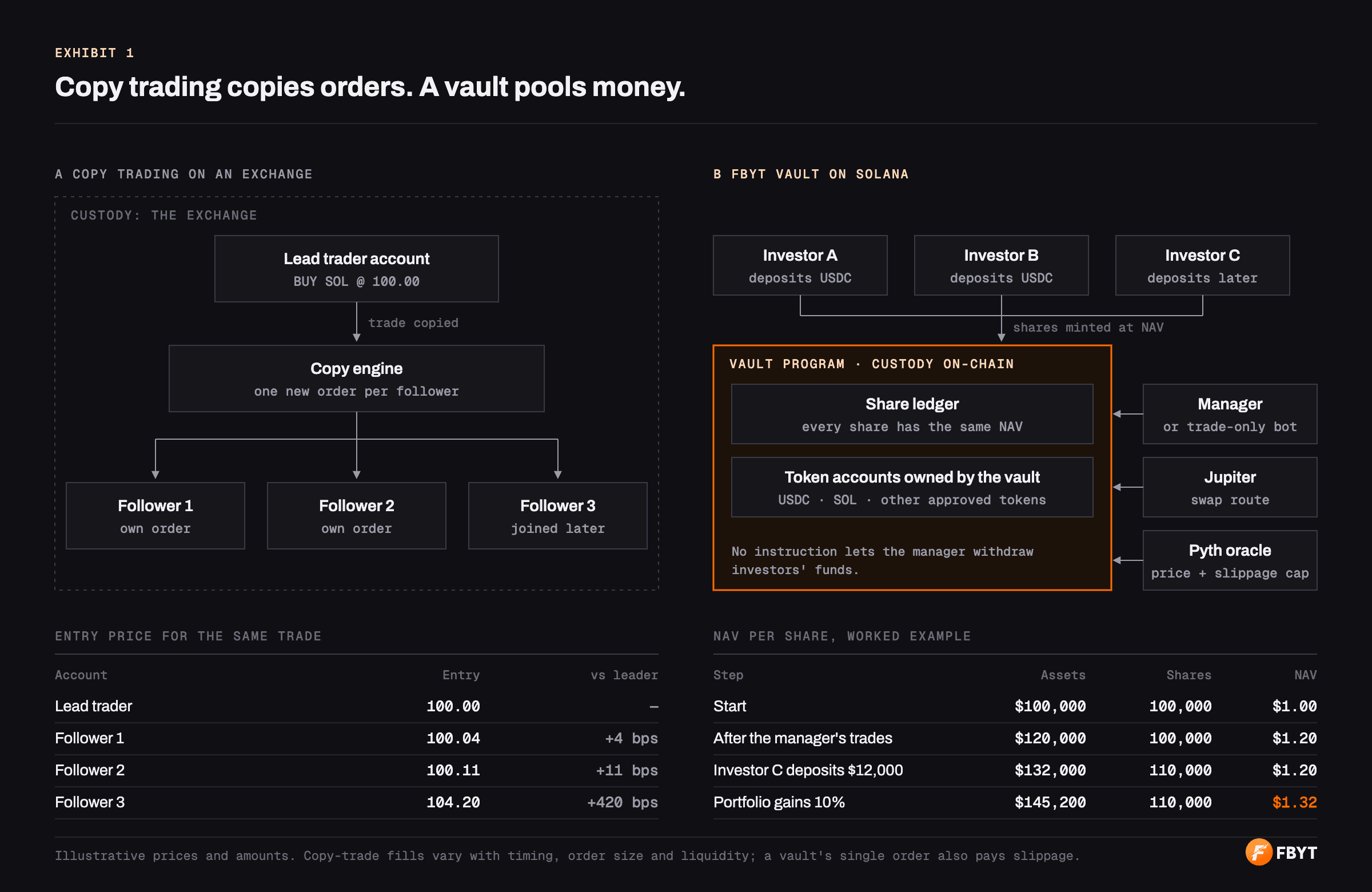
Copy trading and asset management both let someone else trade for you, but they are built differently. In copy trading, a platform copies a lead trader's orders into your own account, one order per follower. Every follower ends up with separate positions and a separate result. In asset management through a fund or vault, investors pool their money into one portfolio, own shares of it priced at net asset value (NAV), and a manager trades the whole pool under a fixed set of rules. That difference in structure decides what price you get, what the trader can do with your money and how both of you are paid.
This guide explains the two models side by side, using the exchanges' and brokers' own documentation, regulators' guidance and academic research. FBYT, which publishes it, runs vaults on Solana, so we also show how one on-chain vault implements the fund model, and when copy trading is the better choice.
Key Takeaways
- Copy trading copies orders into separate accounts; a fund or vault pools money into one portfolio that investors own shares of.
- Followers rarely match the leader: each copied order fills at its own price, and late followers start from a different point. In a 2025 study of 164,634 eToro traders (2013 data, mostly forex), copied trades averaged −61.24 basis points per trade against −6.88 for traders' own trades.
- ESMA and the UK FCA say copy trading that runs automatically, with no client action, can be portfolio management. The useful line is individual accounts versus a pooled vehicle, not "managed" versus "not managed".
- High-water marks don't separate the two: Bitget applies one per follower. Pooling, NAV pricing and an enforced mandate do.
What Is the Difference Between Copy Trading and Asset Management?
The short answer: in copy trading you own a copy of someone's trades, while in a fund or vault you own a share of their portfolio. Everything else follows from that.
| Copy trading | Fund or vault (asset management) | |
|---|---|---|
| What you own | Positions in your own account, opened by a copy engine | Shares of one pooled portfolio |
| Who places the order | The platform sends a separate order per follower | The manager places one order for the pool |
| Price you get | Your own fill, which depends on timing, size and liquidity | The same return per share as every other investor |
| Joining late | You copy the trader's next trades, or buy their open positions at today's price | You buy shares at today's NAV |
| What limits the trader | The platform's settings and your own risk controls | A mandate written into the fund documents or the vault's program |
| How the trader is paid | Profit share per follower (Binance, Bitget) or pay based on copied assets (eToro) | Management and performance fees charged on the pool |
| Where your money sits | Your account at the exchange or broker | The fund's custodian, or the vault's on-chain accounts |
| Track record | The leader's account result, not yours | NAV per share, which is every investor's result |
Social trading is the wider category: sharing ideas, following traders and copying them. Copy trading is its automated version. If you are new to it, start with what copy trading is and how it works.
How Copy Trading Works on Binance, Bitget and eToro
Copy trading works by replicating each of the lead trader's orders into every follower's account, sized by a rule the follower picks. The details vary by platform, and they matter.
Binance. Futures copy trading offers a fixed amount per trade or a fixed ratio to the lead's position, run from a separate copy-trading account (Binance Futures copy trading FAQ). Slippage protection applies to opening orders only: 0.5% by default on BTC and ETH and 1.5% on other pairs. Closing orders are not protected. On spot copy trading, buys go in as limit orders and sells as market orders (Binance spot copy trading guide).
Bitget. Lead traders set their own profit share and can change it at any time. Bitget applies it with an explicit high-water mark: "the same profit will only be shared once" (Bitget). Futures profit share settles daily when no positions are open, and immediately when you stop copying.
eToro. CopyTrader copies in proportion to the trader's allocation as a share of their equity, with a $200 minimum per trader. Copied positions under $1 are not opened. By default, you also copy the trader's current open positions at today's prices, and you can turn this off (eToro, how CopyTrader works). Your money stays in your own eToro account.
In every case the follower's account is separate. The platform tries to make it look like the leader's, but it is a different set of orders placed at different moments.
How a Fund or Vault Works
A fund or vault works by pooling investors' money into one portfolio and tracking each investor's slice with shares. The portfolio's value divided by the number of shares is the net asset value per share. With $100 million of assets and 10 million shares, NAV is $10 a share (Investor.gov, net asset value).
New money buys shares at the current NAV, and leaving investors redeem at the current NAV. US mutual funds must use the next NAV computed after an order arrives (SEC Rule 22c-1). That pricing is what makes a pool fair to everyone in it. A newcomer can't buy into past gains for less than they are worth, and someone leaving can't take more than their slice. When the trading costs of entering and leaving fall on the investors who stay, the SEC calls that dilution, and funds use tools such as swing pricing to pass those costs to the investors who cause them (SEC release 33-10234).
On-chain vaults copy this design. Ethereum's ERC-4626 standard defines a tokenized vault whose shares are tokens, with functions to convert between assets and shares and a rule that rounding must favour the vault, not the person depositing or withdrawing (EIP-4626). Solana vaults such as FBYT's use the same idea in their own programs. Our crypto vault guide covers the basics.
Why Does the Structure Matter? Five Consequences
Your Result Is Not the Leader's Result
In copy trading, the leader's published return is not the return followers get. Each follower's order fills at its own price, after the leader's, and a large order can move the price before it fills. Binance's protection covers opening orders only, and eToro skips copied positions under $1, so small accounts can end up holding a different mix of positions from the leader.
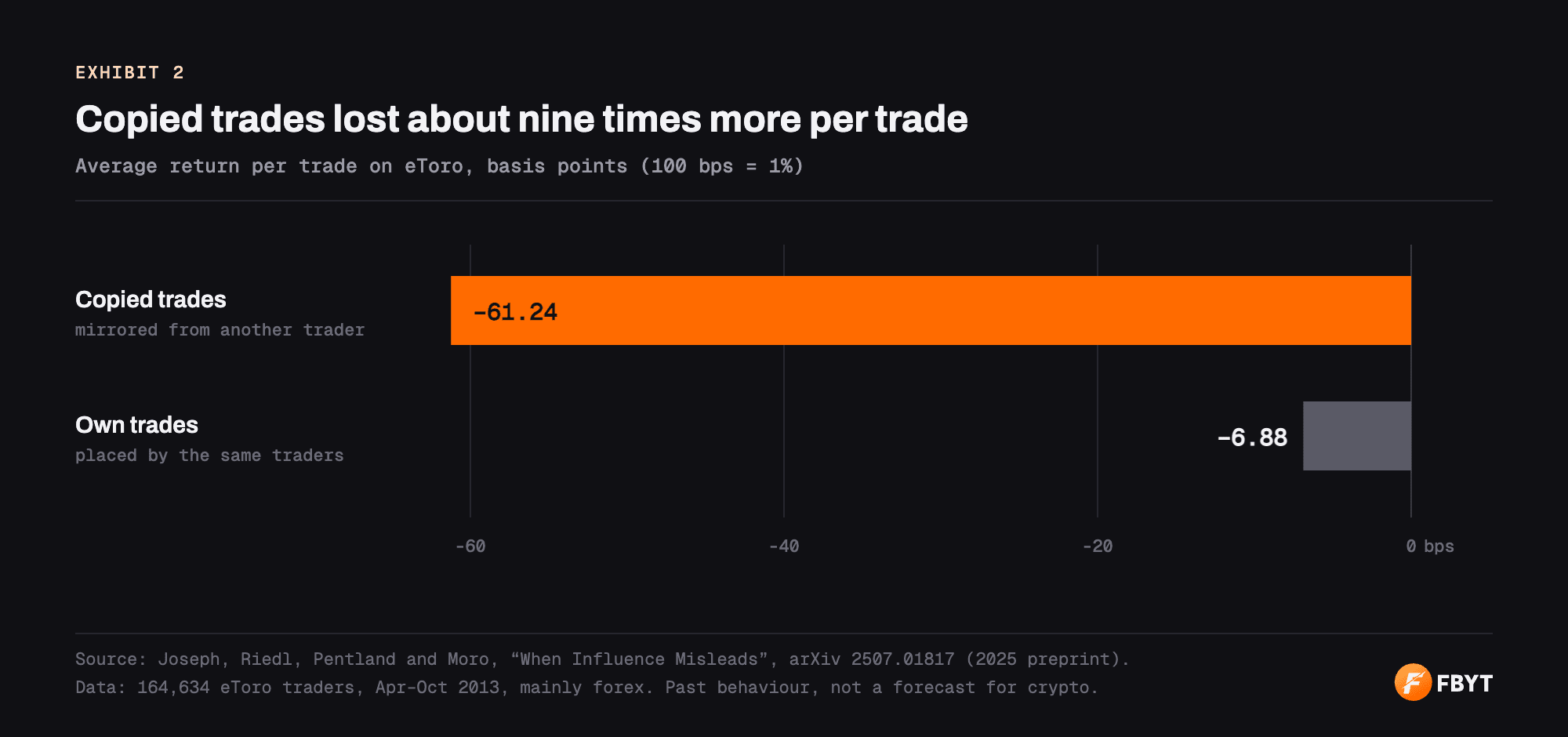
The research on copy trading results is sobering. A 2025 study of 164,634 eToro traders over April to October 2013 found that copied trades averaged −61.24 basis points per trade, while the same traders' own trades averaged −6.88 (Joseph, Riedl, Pentland and Moro, arXiv 2507.01817, preprint). The authors found that people chose whom to copy mainly by popularity, not performance. The data is mostly forex from 2013, so read it as evidence about how copying behaves, not a forecast for crypto. A lab study in Management Science adds that the option to copy pushes people towards more risk (Apesteguia, Oechssler and Weidenholzer, 2020).
In a vault, there is one portfolio and one set of fills. Your return per share is the same as every other investor's, because you all own slices of the same thing. Our guide to whether copy trading is profitable covers the selection side of this problem.
Joining Late: Copying a Book vs Buying at NAV
Timing changes what a follower gets. Suppose a trader bought SOL at $100 and it is now $120. If you start copying on eToro with open trades copied, you buy SOL at $120. The leader's track record still shows the gain from $100 to $120, which you never had. On platforms that don't copy open positions, you wait for the trader's next trade instead.
Both models make a late joiner pay today's price. The difference is what you hold: a vault investor owns the same mix as everyone else, while a copier may hold only the trader's next trades, or the open positions at their own fills and sizes. For example, take an open-ended vault with $100,000 of assets and 100,000 shares, so NAV is $1.00. The manager's trades lift it to $120,000, or $1.20 a share. You deposit $12,000 and receive 10,000 shares at $1.20. The vault now holds $132,000 across 110,000 shares, still $1.20 each. If the portfolio then gains 10%, every share is worth $1.32. In principle you get the return earned after you joined, and earlier investors keep the gains they already had.
How the Trader Gets Paid
Copy-trading leaders are paid per follower. On Binance futures, leaders take up to 30% of copiers' profits plus 10% of their trading fees (Binance FAQ). On spot, the standard share is 10%, rising to 30% for the top Elite tier (Binance Elite Trader program). eToro pays its top Popular Investors 1.5% a year of the average assets copying them, paid monthly (eToro Popular Investor program). That works much like a management fee.
Fund and vault managers charge fees on the pool instead: a management fee on assets and a performance fee on gains, usually above a high-water mark. ESMA's guidelines for UCITS funds require that a performance fee is paid only for positive performance, with past losses made up first, and a high-water mark is one of the models they describe (ESMA34-39-992). High-water marks exist on both sides, as Bitget's per-follower rule shows. The difference is what the fee is charged on: your separate account, or your share of a portfolio everyone owns together. Our guide to vault fees and high-water marks shows the maths.
What Limits the Trader
A copy-trading leader is limited by what the platform lets them trade, plus whatever risk settings you add, such as eToro's copy stop-loss. The leader can switch strategy, raise leverage or trade a new market, and your account follows unless your copy settings block it.
A fund manager works under a mandate: the assets, venues and risk limits written into the fund's documents. An on-chain vault can enforce its mandate in code, which is the main thing a blockchain adds. In FBYT's vault program, for example, the manager can only swap through Jupiter, and only into tokens with an approved Pyth price feed. Every swap is checked against those oracle prices and rejected if it loses more than a protocol-wide slippage limit that FBYT sets. Each vault's fees are set when it is created, within caps FBYT sets (currently 15% a year management and 20% performance), and the manager cannot raise them afterwards. The program has no instruction that lets the manager withdraw investors' money. The manager can still lose money through bad trades, and each swap can lose up to the slippage limit.
Where Your Money Sits
In copy trading, your money sits in your account at the exchange or broker, so you carry the platform's custody risk. Our best copy trading apps guide covers exchange failures. A licensed broker is bound by its regulator's conduct rules and, in some countries, an investor compensation scheme. A crypto exchange usually offers less.
In a traditional fund, a separate custodian holds the assets. In an on-chain vault, they sit in accounts controlled by the vault's program. On FBYT that means token accounts owned by the vault's program-derived address, with no instruction that lets the manager withdraw investors' money. The risk moves from a company to code: smart-contract bugs, oracle errors and admin settings. Our non-custodial vault safety guide explains what to check.
Is Copy Trading Regulated as Asset Management?
In the EU and UK, often yes, and this is the point most comparisons miss. ESMA's 2023 supervisory briefing on copy trading says copy trading can qualify as portfolio management or investment advice under MiFID II, depending on how it works. Automatically executing someone else's trades, with no action from the client, can count as portfolio management (ESMA35-42-1428). ESMA also flags pay based on follower numbers or copied assets as a source of conflicts of interest. The UK's FCA says copy trading with no manual input from the account holder is portfolio management that needs authorisation (FCA, copy trading).
For crypto, ESMA said in April 2025 that MiCA does not define copy trading and that crypto firms should assess each model case by case using the MiFID guidance (ESMA Q&A 2463). Ahead of MiCA, Binance switched off copy trading for users in the European Economic Area in June 2024 and closed remaining positions at market (Finance Magnates).
So the line regulators draw is about how much the client decides, not "managed" versus "unmanaged". Copy trading runs account by account; a fund or vault runs one pooled vehicle. Whether a particular vault is regulated depends on its structure and where it operates.
Where Hyperliquid Vaults Fit
Hyperliquid's native vaults are pooled, so they sit on the fund side, not the copy-trading side. Depositors share profits and losses in proportion to their deposit, the leader must keep at least 5% of the vault and takes 10% of profits, and deposits are locked for one day in user vaults and four days in HLP (Hyperliquid, vault leaders). Hyperliquid's docs describe vaults, not a copy-trading feature; copy trading there happens through third-party tools that mirror wallets. We compare the vaults with FBYT's in FBYT vs Hyperliquid vaults.
It helps to think of a spectrum rather than two boxes. Forex brokers' PAMM and MAM accounts, where a manager trades pooled or allocated client funds at the broker, sit between copy trading and a fund:
| Model | Pooled? | Mandate enforced? | Example |
|---|---|---|---|
| Copy trading | No, separate accounts | Platform settings, plus conduct rules where the platform is licensed | Binance, Bitget, eToro |
| Managed broker account (PAMM/MAM) | Allocated at the broker | Broker's rules and licence | Forex brokers |
| Pooled vault, open mandate | Yes | Leader can trade anything listed | Hyperliquid user vaults |
| Pooled vault, coded mandate | Yes | Venue, assets, fees and withdrawals limited by the program | FBYT; on Ethereum, Enzyme |
| Regulated fund | Yes | Fund documents, custodian, auditor, regulator | UCITS funds, hedge funds |
When Is Copy Trading the Better Choice?
Copy trading suits some investors better, and a fair comparison should say so.
- You want control per trade. You can close one copied position, pause, or keep positions when you stop copying. In a vault you own a slice of the whole portfolio.
- You want leverage or derivatives. Centralised exchanges offer leveraged futures copy trading. FBYT vaults trade spot only, with no leverage inside the vault.
- You want a regulated intermediary. A licensed broker brings investor-protection rules and, in some countries, compensation schemes.
- You don't want smart-contract risk. A vault replaces company custody with code, and code can have bugs.
A vault suits investors who want the trader's actual portfolio result, entry at the vault's current NAV, limits the trader can't override, and records anyone can check on-chain. On Ethereum, Enzyme is one such platform. For a wider decision, including trading yourself, see crypto vault vs trading yourself.
How Can You Tell Which One You're Looking At?
Five questions settle it on any platform:
- Do I own positions, or shares? Separate positions in your account mean copy trading. Shares or a vault token mean a pooled vehicle.
- How is my entry priced? At NAV means a fund structure. At the market price of the leader's open book means copying.
- Who places the orders? One order for everyone means a pool. One order per follower means copying.
- What stops the trader from changing strategy or taking the money? Look for a written mandate, or limits enforced by the program, rather than platform settings.
- What is my fee charged on? Your own account's profit, or your share of the pool.
The Bottom Line
Copy trading and asset management differ in structure, not in who trades. Copy trading gives you a copy of a trader's orders in your own account: flexible and familiar, but your result drifts from the leader's, and the trader answers mainly to the platform's settings. A fund or vault gives you a share of one portfolio, priced at NAV, run under a mandate. On-chain, that mandate can be enforced by code and checked by anyone.
FBYT vaults apply the fund model on Solana. Managers trade spot tokens through Jupiter from accounts owned by the vault's program, and every trade is on-chain. FBYT's vault program has been through an internal security audit, and FBYT is working with external auditors. No independent audit report has been published yet. If that model fits you, browse FBYT vaults and read a manager's on-chain record before you deposit.