


The best Solana vault for you depends on what you want the vault to do. Lending vaults such as Kamino Earn and Jupiter Lend earn interest on one token. Protocol vaults such as Jupiter's JLP pool and Solstice's eUSX earn trading fees or basis yield. Manager-run strategy vaults such as Neutral Trade, Exponent and FBYT hand your deposit to a named trader or firm. This guide compares eight live options on custody, who decides, fees and how fast you can get your money out. The facts come from each platform's own documentation as of 2 November 2026.
Disclosure: FBYT publishes this page and FBYT is one of the platforms listed. We have not scored or ranked anyone. Platforms are grouped by vault type and listed alphabetically within each group. The order is not a quality ranking. Every third-party figure is cited, FBYT's facts come from its own smart contract and settings, and anything we could not confirm is marked.
Key Takeaways
- "Solana vault" covers four different products: lending vaults, protocol liquidity vaults, yield-bearing stablecoin vaults and manager-run strategy vaults. Compare like with like.
- Of the platforms compared here, the largest by TVL on 2 November 2026 were Kamino Lend ($1.23B across all its lending) and Jupiter Lend ($998M), per DefiLlama (Kamino, Jupiter Lend).
- Withdrawal terms vary widely: instant or queued (lending), weekly redemptions (Neutral Trade), a 7-day cooldown (Solstice eUSX).
- 2026 changed the list. Drift Vaults are not deployed after Drift's $285 million exploit, and Ranger Finance is winding down, so many older "best vaults" articles are out of date.
What Counts as a Solana Vault?
A Solana vault is an on-chain account that pools deposits and puts them to work under a fixed set of rules, giving each depositor a claim on the pool. What changes from one vault to the next is who decides how the money is used and what it can be used for. For the basics, see our guide to what a crypto vault is; for the design trade-offs, see four types of DeFi vaults compared.
On Solana in late 2026 the live options fall into four groups. Below, we cover the protocol and stablecoin vaults together, because in both the protocol, not a person, runs the strategy.
- Lending vaults put one token to work across lending markets. A curator or an algorithm chooses where.
- Protocol liquidity vaults make you the counterparty to a protocol's traders, as Jupiter's JLP pool does for Jupiter Perps.
- Yield-bearing stablecoin vaults pay the return of a delta-neutral strategy run by the protocol, as Solstice's eUSX does.
- Manager-run strategy vaults let a named trader or firm trade the pooled money, within limits written into the vault's program.
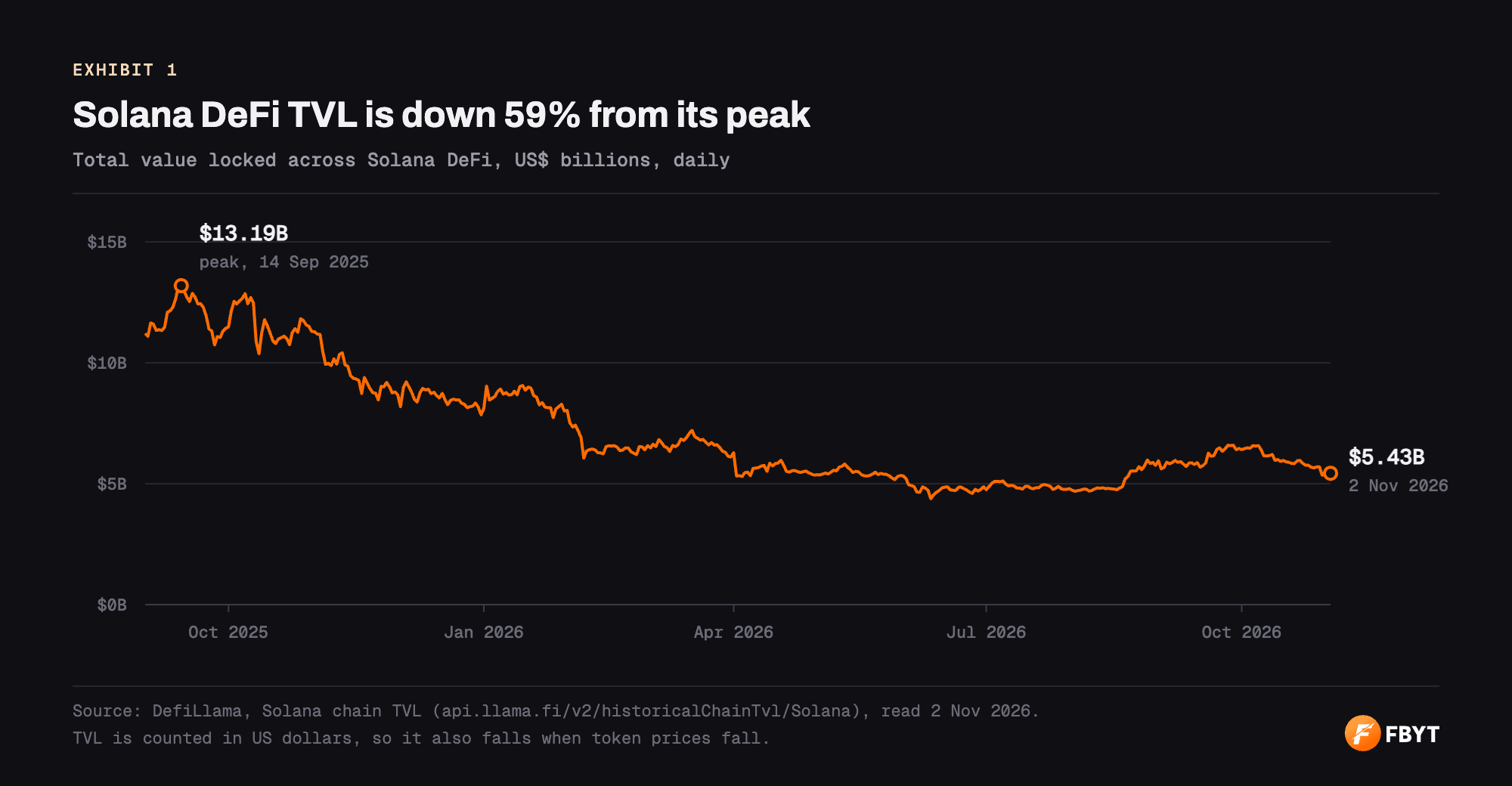
The market these vaults sit in has shrunk. Solana DeFi TVL was $5.43 billion on 2 November 2026, down from $11.19 billion a year earlier and a peak of $13.19 billion on 14 September 2025 (DefiLlama, Solana chain, read 2 November 2026). TVL is counted in dollars, so it falls when token prices drop as well as when deposits leave. Read it as a measure of size, not of quality.
Solana Vaults Compared at a Glance
| Platform | Vault type | Who decides | Custody of deposits | Fees to depositors | Withdrawals |
|---|---|---|---|---|---|
| Jupiter Lend Earn | Lending | Protocol algorithm | Program-owned pools | 10% of borrower interest to treasury | Dynamic withdrawal limits |
| Kamino Earn | Lending | A curator per vault | Program-owned vault accounts | Performance and AUM fee set per vault | Instant from buffer, else FIFO queue |
| Lulo | Lending aggregator | Rules-based allocation | Deposited into underlying protocols | 10% of yield | Boost has a lock-up; length not on docs page |
| Jupiter JLP | Protocol liquidity | Protocol | Program-controlled pool | 0.20% base mint/burn fee, adjusts with pool weights | No lock-up; burn JLP for pool assets |
| Solstice eUSX | Yield-bearing stablecoin | Protocol | Not found in docs we read | Not found in docs we read | 7-day cooldown (24h up to $1,000) |
| Exponent Strategy Vaults | Manager-run strategy | Vault manager | Vault accounts; Squads policies gate manager actions | Set by manager, stored on-chain | Queue filled by manager |
| FBYT | Manager-run strategy | Vault manager or a trade-only delegate | Token accounts owned by the vault's program address | Set by manager at launch, within caps of 15%/yr mgmt and 20% perf | After the fundraising period and any cooldown the manager set |
| Neutral Trade | Manager-run strategy | Vetted trading firms | Program limits transfers to approved addresses | 1% mgmt, 20–35% perf, 0.3% withdrawal (most vaults) | Weekly or twice-weekly redemptions |
Lending Vaults
Lending vaults are the largest group in this guide by TVL. You deposit one token, the vault lends it out, and you earn interest. The main risks are bad debt in the markets the vault lends into and running short of liquidity when many depositors leave at once.
Jupiter Lend Earn
Jupiter Lend's Earn pools are single-asset lending pools: you deposit a token and receive a jlToken, such as jlUSDC, that grows in value as borrowers pay interest (Jupiter Lend docs). Rates are set by algorithm, and 10% of borrower interest goes to the treasury as a reserve factor. There is no curator choosing allocations.
Jupiter Lend passed Kamino as Solana's largest lender on 6 October 2026, per DefiLlama data reported by Crypto Briefing. By 2 November Kamino Lend was ahead again ($1.23B against $998M on DefiLlama). Jupiter Lend's withdrawal limits are dynamic, and a market-wide liquidity crunch at the end of October 2026 showed what that means in practice. On 30 October the USDC pool had about 419.6 million USDC supplied and about 7,900 USDC available to withdraw, with Jupiter reporting no losses (Solana Compass). Jupiter lists ten audits of the lending program, including Certora formal verification and a Code4rena contest in early 2026 (Jupiter audits).
Kamino Earn Vaults
Kamino's Earn vaults are single-token vaults that lend across Kamino Lend reserves. Each vault has one curator, such as Gauntlet or Steakhouse, who sets allocation targets and has discretion over them without a governance vote on each decision (Kamino, Curators & Fees). Gauntlet's own documentation lists what a curator can do: allocate, set caps, set fees and deallocate (Gauntlet VaultBook).
Deposits sit in vault token accounts controlled by the program. A vault can be restricted to Kamino-whitelisted reserves, enforced at protocol level even if the curator's admin key is compromised (Kamino, Curators). Curators earn a performance fee on yield and an AUM fee, set per vault; there is no deposit fee. Withdrawals are instant when the vault's buffer and reserve liquidity allow. A typical buffer is 5–10% of assets; beyond that, requests join a first-in, first-out queue that fills as borrowers repay (Kamino, Liquidity and withdrawals).
The vault program has been audited by Offside Labs (April 2025), Sec3 (February 2025) and OtterSec (December 2024) (Kamino audits). We found no reported exploit of Kamino's vaults. On 29 October 2026 Kamino paused new borrowing in its SOL/BTC market as a precaution during the same liquidity crunch and said it had no exposure to the hack at Binance that set it off (Solana Compass, 30 October 2026).
Lulo
Lulo is a rules-based stablecoin aggregator that spreads deposits across Kamino, Jupiter and Neutrl on Solana, and Morpho, Pendle and Maple on Ethereum (Lulo, integrated protocols). It has two tiers. Boost depositors take first loss to protect Protected depositors. That protection does not cover network outages, stablecoin depegs or bugs in Lulo's own contracts (Lulo, Protected). Lulo charges 10% of the yield (Lulo, Boost).
The tier system was tested on 20 October 2026, when Lulo said Boost deposits faced a drawdown of about 6.4% from exposure to Neutrl's NUSD, while Protected deposits were not affected (The Defiant). Boost has a lock-up, but its length is not stated on the docs page we read.
Protocol Vaults
In a protocol vault no manager makes choices. The protocol's rules set the strategy, and your return depends on how that strategy performs.
Jupiter JLP
JLP is the liquidity pool behind Jupiter Perps: its holders are the counterparty to every perps trader on the exchange (Jupiter, JLP). The pool holds SOL, ETH, wBTC and stablecoins, so a JLP holder carries price exposure to those assets plus the risk that traders win. In return the pool earns 75% of perps fees on those markets, with 25% going to Jupiter. Minting and burning JLP costs a 0.20% base fee that moves with the pool's target weights. There is no lock-up; when the pool reaches its AUM cap, new JLP can only be bought on the market.
Solstice eUSX
Solstice's YieldVault lets you lock its USX stablecoin to receive eUSX, a token that accrues the return of Solstice's delta-neutral strategies (Solstice, eUSX). Unlocking takes a 7-day cooldown, or 24 hours for amounts up to $1,000; you can also sell eUSX on a DEX. Halborn audited the USX, staking and rewarder programs between March and December 2025 (Solstice audits). The docs we read do not state the fees, the trading venues or who holds the strategy's collateral, so ask before depositing.
Manager-Run Strategy Vaults
Manager-run vaults are the closest thing on Solana to a fund. A person or firm makes the trading decisions, and the vault's program limits what they can do with the money. This is the group to read most carefully, because the limits are what protect you from the manager. Our guide on how to read a Solana vault on-chain shows how to check them yourself.
Exponent Strategy Vaults
Exponent's Strategy Vaults are managed funds in which every action the manager takes must pass policies enforced through Squads, Solana's multisig and account-control program (Exponent, strategy vaults). Managers can allocate to Exponent's own markets, Kamino Lend, Loopscale and Titan. Fees (management, performance and withdrawal) are set by the manager and stored on-chain, and Exponent adds no fee of its own (Exponent, risks and fees). Withdrawals go into a queue that the manager fills, which can take time while positions are unwound. OtterSec and Adevar Labs audited the vault program in April and May 2026, with a Certora review pending (Exponent audits).
FBYT
FBYT is the platform that publishes this page, so here are its facts, read from its smart contract and production settings on 2 November 2026. FBYT vaults trade spot tokens on Solana through Jupiter, with no leverage inside the vault. Deposits sit in token accounts owned by the vault's program-derived address. The current vault program has no instruction that lets a manager withdraw investors' money, and a trading delegate, such as a bot, can trade but cannot withdraw. For the full design, see FBYT's security and vault architecture.
Managers set a management fee and a performance fee when they create a vault, within caps FBYT sets (currently 15% a year and 20%), and cannot raise them afterwards. The performance fee is charged only above each investor's high-water mark; our guide to DeFi vault fees explains how it works. Withdrawals open after the vault's fundraising period and any cooldown the manager set, shown on each vault, and pay out a share of every token the vault holds. FBYT's vault program has been through an internal security audit, and FBYT is working with external auditors. No independent audit report has been published yet.
Neutral Trade
Neutral Trade runs USDC vaults managed by outside trading firms it vets (it calls them curators), with strategies such as funding-rate arbitrage, market making, trend following and options, across centralised and decentralised venues (Neutral Trade, strategy vaults). Curators can trade but cannot withdraw. The program limits fund movements to pre-approved addresses, and parameter changes need several approvals and a 12-hour timelock (Neutral Trade, vault protections).
Most vaults charge a 1% management fee, a 20–35% performance fee and a 0.3% withdrawal fee, with a 100 USDC minimum (Neutral Trade, fees and redemption). Redemptions run weekly or twice a week, and requests cannot be cancelled. Neutral Trade lists audits by Halborn (January 2025), Quantstamp (June 2025), Offside Labs (December 2025) and Adevar Labs (October 2026) (Neutral Trade, security). We compare it with FBYT in detail in Neutral Trade vs FBYT.
What Changed for Solana Vaults in 2026?
Four events in 2026 explain why some well-known names are missing from this list.
- Drift Vaults are not live. On 1 April 2026 Drift lost about $285 million when attackers took over its admin controls through socially engineered signers and a fake collateral token, according to TRM Labs. Drift's documentation now points to Velocity, whose vault page says the vaults program is not deployed (Velocity docs). Our FBYT vs Drift Vaults comparison covers the incident in detail.
- Ranger Finance is winding down. Ranger announced a wind-down in May 2026 (SolanaFloor).
- Meteora's Dynamic Vault is now "legacy". Meteora files it under legacy products, with only a Jupiter Lend strategy still running (Meteora docs). It still held $45.8 million on 2 November 2026 (DefiLlama), but we left it out of the main list for that reason.
- Withdrawal limits were tested. Lulo's Boost drawdown on 20 October and the queues at Jupiter Lend on 30 October showed that "withdraw any time" in a lending vault depends on borrowers repaying.
The Drift case is the lesson most relevant to choosing a vault: the loss came from who could change the protocol's rules, not from a bug in the vault code.
How to Compare Solana Vaults Yourself
Five questions sort most vaults quickly. You can answer all of them from a platform's docs and its on-chain accounts.
- Who can move the money? Look for the exact limit: program-owned accounts, approved destination addresses, or a multisig. "Non-custodial" on its own tells you little. Our guide to non-custodial vault safety lists what to check.
- Who can change the rules, and how fast? Admin keys, multisigs, timelocks and upgrade rights matter more than the strategy, as Drift showed.
- How do withdrawals work under stress? Instant, queued, weekly or after a cooldown. Read the terms for a bad week, not a normal one.
- What do you pay, and who sets it? Management, performance, withdrawal and protocol fees, and whether the manager can change them later.
- What has been audited, by whom, and when? Check that the audit covers the program you are depositing into and is recent.
Not on Solana: Hyperliquid Vaults
Hyperliquid vaults often come up in the same searches but run on Hyperliquid's own chain. Anyone can create one for 10,000 USDC; the leader must keep at least 5% of the vault and takes 10% of profits; deposits are locked for one day in user vaults and four days in HLP, the protocol vault (Hyperliquid docs). We compare them with FBYT in FBYT vs Hyperliquid vaults.
Which Solana Vault Fits You?
The right vault follows from the job you want done. For interest on a stablecoin with fast exits in normal markets, a lending vault such as Kamino Earn or Jupiter Lend fits; check the withdrawal queue rules. For a protocol-run return with no manager in the loop, look at JLP or eUSX, and accept JLP's price exposure or eUSX's 7-day cooldown. For a trader's or firm's strategy, the manager-run vaults (Neutral Trade, Exponent and FBYT) fit, and the deciding factors are the limits on the manager, the fees and the redemption schedule.
Whichever you choose, read the vault's own page on the day you deposit. Fees, caps and terms change, and several facts in this guide are less than a month old.


